Logo and brand guide
Full-color logo (PNG, JPG, vector PDF) and the CSVANW Brand Quick Guide.
Download all (ZIP, 1.9 MB)Organization boilerplate
Approved descriptions of CSVANW, ready to copy into your story.
Go to boilerplateFind approved information, organizational background, brand assets, statistics, and resources for covering the Coalition to Stop Violence Against Native Women (CSVANW) and issues impacting Native survivors, families, and communities.
At a glance
About CSVANW
CSVANW is a Native-led tribal coalition working to eliminate violence against Native women and children in New Mexico. Through training, technical assistance, policy advocacy, and support, CSVANW works alongside Tribal communities, advocates, leaders, and partners to strengthen responses to violence and create healthy, violence-free communities.
Full organizational name
Coalition to Stop Violence Against Native Women (CSVANW)
Approved acronym
CSVANW
Tagline
Healthy Families, Healthy Communities.
Founded
1995
Headquarters
Albuquerque, New Mexico
Primary service area
New Mexico's Tribal communities
Mission
The mission of the CSVANW (Coalition to Stop Violence Against Native Women) is to eradicate violence against Native women and children by championing social change within our communities. We are dedicated to taking responsibility for the future wellbeing of Native women and children.
Vision
Our vision encapsulates the essence of our efforts: fostering Healthy Families, Healthy Communities. This vision guides our commitment to healing and transforming our communities into safe, nurturing spaces for the growth and prosperity of all its members.
Service area
CSVANW works with Tribal communities, advocates, service providers, Tribal leadership, and partners throughout New Mexico to strengthen prevention and responses to violence against Native women and children. The Coalition is headquartered in Albuquerque, New Mexico, and provides training, technical assistance, policy advocacy, community support, and educational resources.
History
Founded in 1995, CSVANW was organized by three Native women: Peggy Bird (Kewa), Darlene Correa (Laguna Pueblo), and Genne James (Navajo). The Coalition was created to support Native advocates working to address domestic violence, sexual assault, dating violence, stalking, and sex trafficking in New Mexico's Tribal communities. Their founding goal was clear: eliminate violence against Native women and children. Today, CSVANW continues that work through training, technical assistance, policy advocacy, support, and partnerships with Tribal communities.
Ready to use
Boilerplate
Use these approved descriptions when referring to CSVANW in articles, programs, and partner materials.
Media boilerplate (63 words)
The Coalition to Stop Violence Against Native Women (CSVANW) is a Native-led tribal coalition working to eliminate violence against Native women and children. Founded in 1995, CSVANW provides training, technical assistance, policy advocacy, and support while building meaningful partnerships with Tribal communities, advocates, leaders, and organizations. Through education, advocacy, collaboration, and community-driven solutions, CSVANW works toward its vision of Healthy Families, Healthy Communities.
Organizational background (151 words)
The Coalition to Stop Violence Against Native Women (CSVANW) is a Native-led tribal coalition dedicated to eliminating violence against Native women and children and creating healthy, violence-free communities. Founded in 1995 by three Native women—Peggy Bird (Kewa), Darlene Correa (Laguna Pueblo), and Genne James (Navajo)—CSVANW was created to support Native advocates addressing domestic violence, sexual assault, dating violence, stalking, and sex trafficking within New Mexico's Tribal communities.
Today, CSVANW continues this legacy through four primary areas of work: training, technical assistance, policy advocacy, and support. The Coalition works alongside Tribal communities, advocates, leadership, service providers, and partners to strengthen responses to violence while advancing prevention, education, policy, and community-driven solutions.
CSVANW's approach is grounded in meaningful and authentic partnerships built on respect and the understanding that Tribal communities hold knowledge, strength, and solutions. Through collective action, education, advocacy, and relationship building, CSVANW works toward its vision of Healthy Families, Healthy Communities.
Our work
What we do
CSVANW has four main areas of focus:
01
Training
Providing education and learning opportunities that strengthen knowledge, skills, and community responses to violence.
02
Technical Assistance
Providing guidance, resources, and support to Tribal communities, advocates, programs, and partners working to prevent and respond to violence.
03
Policy Advocacy
Advocating for policies, systems, and approaches that strengthen protections for Native women, children, families, and communities.
04
Support
Strengthening advocates, organizations, and Tribal communities through resources, collaboration, relationship-building, and connection.
Our approach
CSVANW's work is grounded in one fundamental value: engaging Tribal communities and supporting community-driven solutions through meaningful and authentic partnerships and relationships built on respect.
We recognize that Tribal communities hold knowledge, strengths, and solutions. Our role is to work alongside communities to support approaches that promote safety, healing, prevention, and lasting change.
For interviews and background
Issues and areas of expertise
CSVANW works across interconnected issues impacting Native women, survivors, families, youth, and Tribal communities. Our staff and subject-matter experts may be available to provide education, context, resources, and interviews in the following areas:
Domestic Violence & Intimate Partner Violence
Sexual Violence
Missing and Murdered Indigenous Women and Relatives (MMIWR)
Sex Trafficking
Advocacy for Native Survivors
Healthy Relationships & Consent for Native Youth
Policy & Systems Advocacy
Violence Against Native Women & Native Communities
Healthy Masculinity
CSVANW approaches these issues through a Native-centered, community-driven lens that recognizes the strengths, knowledge, cultures, and experiences of Tribal communities.
4 in 5
American Indian and Alaska Native women have experienced violence in their lifetime (84.3 percent). Source: National Institute of Justice, Violence Against American Indian and Alaska Native Women and Men (2016). More data and policy context: CSVANW Policy Informational Briefs.
Members of the media seeking interviews, background information, expert perspectives, or resources related to these issues are encouraged to contact CSVANW's communications team.
Media contact
Media & interview requests
For interviews, statements, speaking requests, press inquiries, or requests for background information, please contact CSVANW's communications team.
Outreach & Communications Department
Coalition to Stop Violence Against Native Women
Email: [email protected]
Phone: (505) 243-9199
Email the communications teamWho to talk to
Leadership & spokespeople
Coming soon. In the meantime, contact [email protected] and the communications team will connect you with the right spokesperson for your topic.
For reporters and editors
Reporting on violence in Native communities
Coverage shapes how survivors, families, and Tribal communities are seen. These recommendations support accurate, respectful reporting.
01
Use survivor-centered language.
Say "survivor" or "person who experienced violence" unless the person prefers otherwise, and ask how they want to be identified.
02
Report with a trauma-informed approach.
Explain how an interview will be used, let survivors set limits, and do not press for details they choose not to share.
03
Avoid victim-blaming.
Keep the focus on the person who caused harm. Leave out details about what a survivor wore, drank, or "should have" done.
04
Respect Tribal sovereignty.
Tribes, Nations, and Pueblos are sovereign governments. Contact them directly for statements about their communities.
05
Use correct names for Tribes, Nations, and Pueblos.
Name the specific community, as it names itself, rather than a general term.
06
Avoid stereotypes about Native communities.
Violence is not a part of Native cultures. Include the strengths, cultures, and leadership of the community you are covering.
07
Protect survivors' privacy.
Do not publish names, locations, photos, or identifying details without informed consent.
08
Use MMIWR terminology appropriately.
Missing and Murdered Indigenous Women and Relatives. Use the full term on first reference and follow the family's wording for an individual case.
09
Avoid unnecessarily graphic descriptions.
Describe what happened accurately without sensational detail.
10
Center prevention, accountability, healing, and community solutions.
Include resources and the work communities are doing, not only the harm.
Downloads
Brand assets
Download the official CSVANW logo and Brand Quick Guide. Please keep the logo intact: do not stretch, recolor, crop, or add effects to it.
CSVANW logo, full color
Purple logo for use on white or light backgrounds.
Download PNG, transparent background (3000 px, 0.8 MB)Download JPG, white background (3000 px, 0.4 MB)Download PDF, vector for print (0.4 MB)
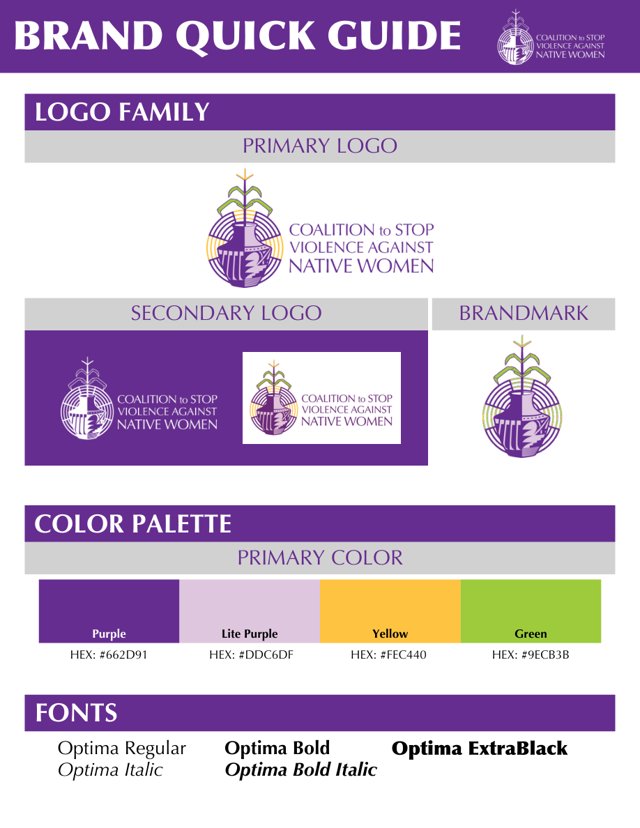
Brand Quick Guide
Logo family, color palette, and fonts on one page.
Download the Brand Quick Guide (PDF, 0.4 MB)Brand colors
Purple
#662D91
Lite Purple
#DDC6DF
Yellow
#FEC440
Green
#9ECB3B
Everything above in one file.
Download all (ZIP, 1.9 MB)